The Banality of Access: How a Movie Rental Log Revealed Jeffrey Epstein’s Grip on High Society
February 3rd, 2026
Written By: Connor Upton
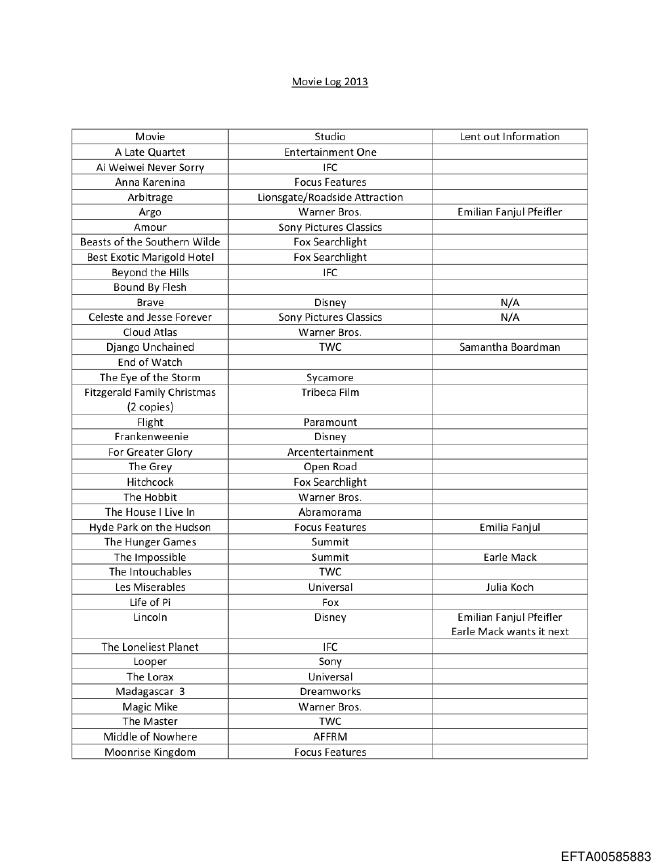
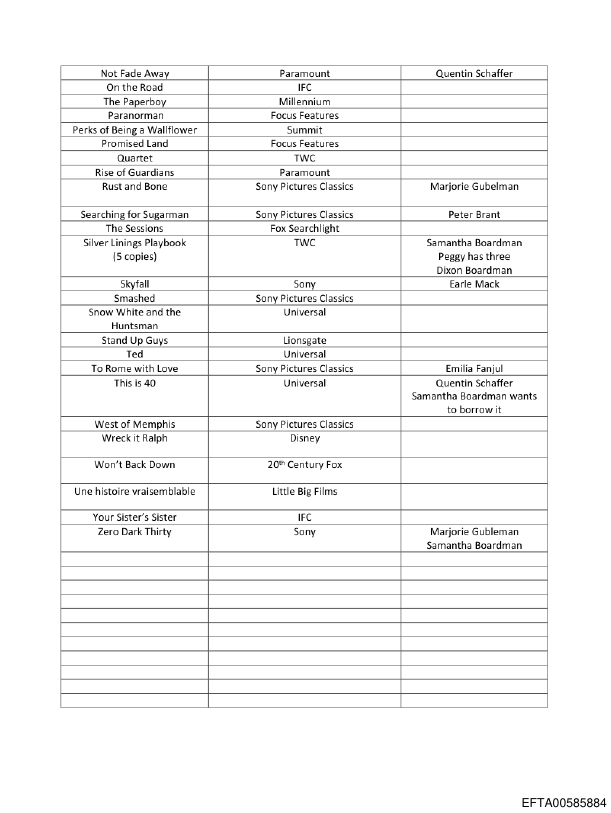
In the mountain of three million pages recently released by the Department of Justice, one of the most damning pieces of evidence of Jeffrey Epstein’s survival in high society is not a flight log or a bank transfer, but a simple unredacted spreadsheet titled “Movie Log 2013”, or EFTA00585883.
The document serves as the central hub for the story of how Epstein and his employees rehabilitated the image of the disgraced financier and sex criminal in the public eye, and how his presence was normalized among elite individuals.
On the surface, the document seems trivial. EFTA00585883 appears to be a housekeeping record tracking DVD screeners of Academy Award contenders like ‘Lincoln’, ‘Argo’, and ‘Silver Linings Playbook’.
But a closer look at the “Lent Out Information” column reveals a startling reality: five years after his 2008 solicitation conviction and registration as a sex offender, Epstein was not a pariah in high society. Epstein was seen as a resource.
The 'Movie Log' shows he had become a lending library for the elite, a place where diplomats, billionaires, and socialites casually borrowed the season’s hottest films, maintaining a mundane domestic intimacy with a man who the world now knows as a monster.
For years, the public narrative has suggested that private society cut ties with Epstein after his Florida conviction. The “Movie Log” captures a specific moment in time, the 2012-2013 awards season, where access to Epstein, and by extension his publicist Peggy Siegal, was still treated as a perk.
The names on the 'Movie Log' are not anonymous or redacted, nor are they accused of any wrongdoing. This type of in-house Blockbuster was simply one perk of knowing Epstein, one which also served to propel him into legitimate circles.
By accepting these small favors, a copy of ‘Skyfall’ here, a viewing of ‘Les Misérables’ there, these figures helped normalize Epstein’s presence, weaving him back into the social fabric at the very moment he should have been exiled.
The log is meticulous, tracking who had which copy and who was waiting in line. Owners of a sugar empire (Pepe & Emilia Fanjul) are mentioned to have been lent out films by Epstein.
One entry concerns ‘Lincoln’, the Steven Spielberg biopic. Next to the title, the staff noted a waitlist: “Earle Mack wants it next”.
Earle Mack is the former United States Ambassador to Finland and a Chairman of the New York State Council on the Arts. The idea that a high-ranking diplomat was effectively queuing up for a rental movie implies casual, ongoing communication that defied the social ban supposedly in place.
Mack was not alone. The log repeatedly lists members of the Fanjul family, the politically powerful owners of Fanjul Corp and Domino Sugar. Emilia Fanjul is listed borrowing ‘Hyde Park on Hudson’ and ‘To Rome with Love’, while Emilian Fanjul Pfeifler checked out ‘Argo’. This was not a transaction of money, but of social currency.
In 2013, physical screeners were status symbols. Early access to Oscar contenders before they hit the general public was privileged. By controlling the supply of these cultural artifacts, Epstein made himself useful to the very people who could offer him protection and legitimacy to rehabilitate his image.
If the “Movie Log” shows that high society continued to consume Epstein’s favors, the question becomes: Who was supplying the contacts that could rehabilitate his image?
The answer lies in the recurrent appearance of Peggy Siegal, the infamous New York publicist known for orchestrating the exact kind of Academy Award campaigns that filled Epstein’s shelves with screeners like Silver Linings Playbook.
But the DOJ files reveal that Siegal was far more than a source of DVDs. She was a paid architect of Epstein’s rehabilitation, and for that she received her share of benefits. The relationship Epstein had with his employees was transactional in the starkest terms.
In EFTA02033290, an email sent to Epstein by longtime assistant Lesley Groff, she writes “Reminder I go to Disney world tomorrow with family. I will be back in the office on Monday dec 19…”
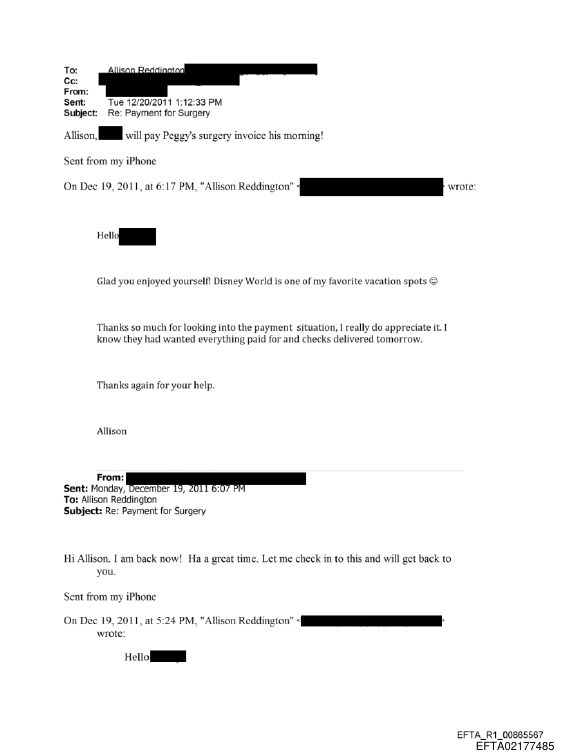
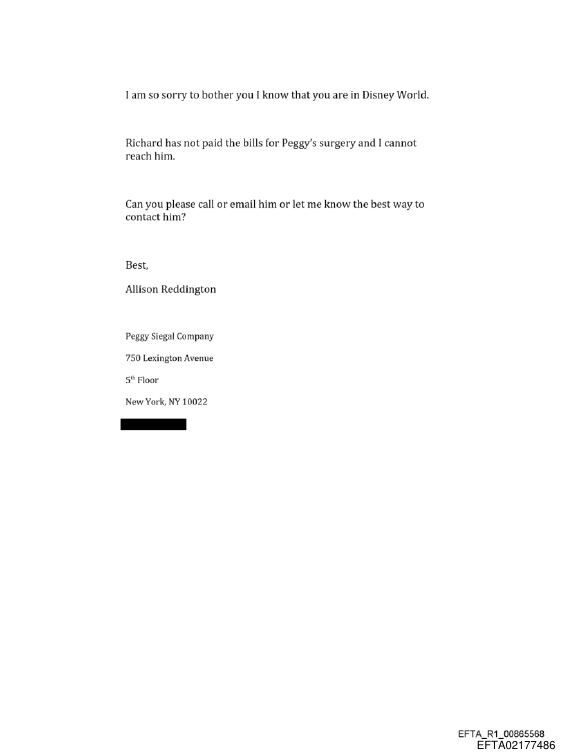
In EFTA02177485, an assistant from the Peggy Siegal Company contacted a member of Epstein’s staff on December 19th, 2011. The recipient's name was redacted in this document by the DOJ. However, the text gives us an insight who it may be. “Hello [REDACTED], I am so sorry to bother you I know that you are in Disney World.”
The redacted recipient writes back, “Hi Allison. I am back now! Ha a great time…”
Based on the date this appears to be Groff, and the reasons why the DOJ redacted her name in this context are not clear. Despite this, the December 2011 email chain shows a web of favors among friends. The email, titled “Payment for Surgery,” features Allison Reddington urgently contacting Epstein’s staff: “Richard has not paid the bills for Peggy's surgery... Can you please call or email him?”.
'Richard' is seemingly Epstein’s accountant Richard Kahn, a principal money handler. Kahn was Epstein’s in-house accountant, and is reported by the New York Times to be a co-executor of Epstein’s estate. The NYT also reported on a file which mapped out Epstein's inner circle, and it includes the names of Kahn and Groff. It can be reasoned that this ‘Richard’ mentioned in the context of finances is this individual.
The response from a redacted sender, presumably Groff, was “Will pay Peggy's surgery invoice this morning!"
Epstein’s money was effectively subsidizing one of New York’s most powerful gatekeepers, and his assistants and accountants were arranging these deals. In exchange, Epstein got the keys to the city and access to powerful individuals.
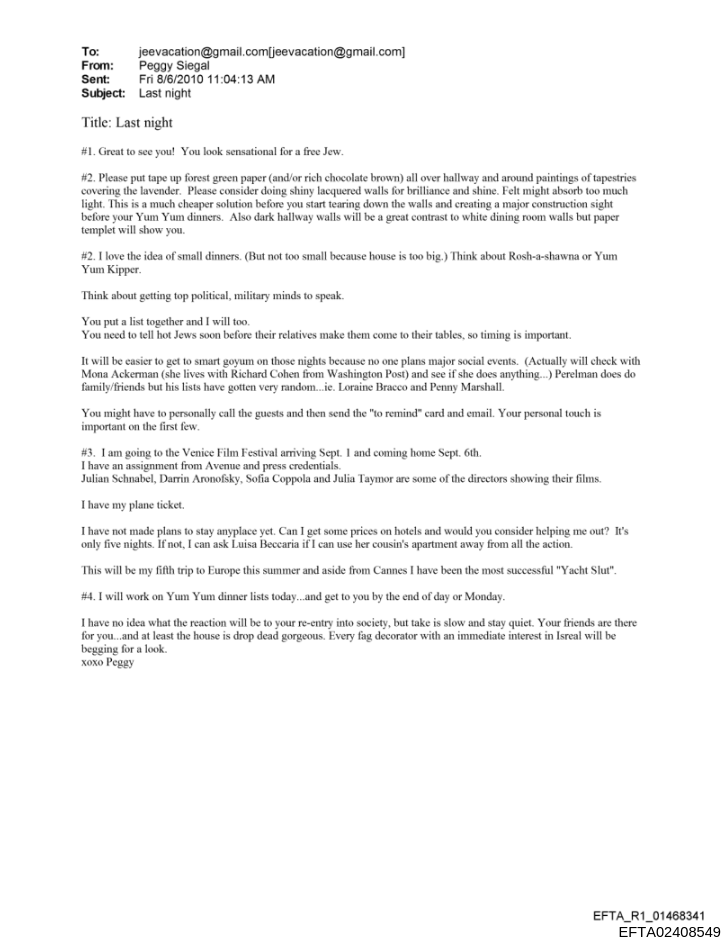
A newly discovered email from August 2010 proves this strategy. In EFTA02408549, a message titled 'Last Night,' Siegal explicitly outlines the plan for Epstein’s post-prison life.
“I have no idea what the reaction will be to your re-entry into society, but take is slow and stay quiet. Your friends are there for you...” she writes, advising him to host small dinners with “top political, military minds” to regain standing. She even frames the holidays as a tactical opportunity to secure guests.
Crucially, the email pivots immediately from strategic advice to a request for financial favors, with Siegal asking Epstein to “consider helping me out” with hotel costs for the Venice Film Festival. The quid pro quo was written in plain text.
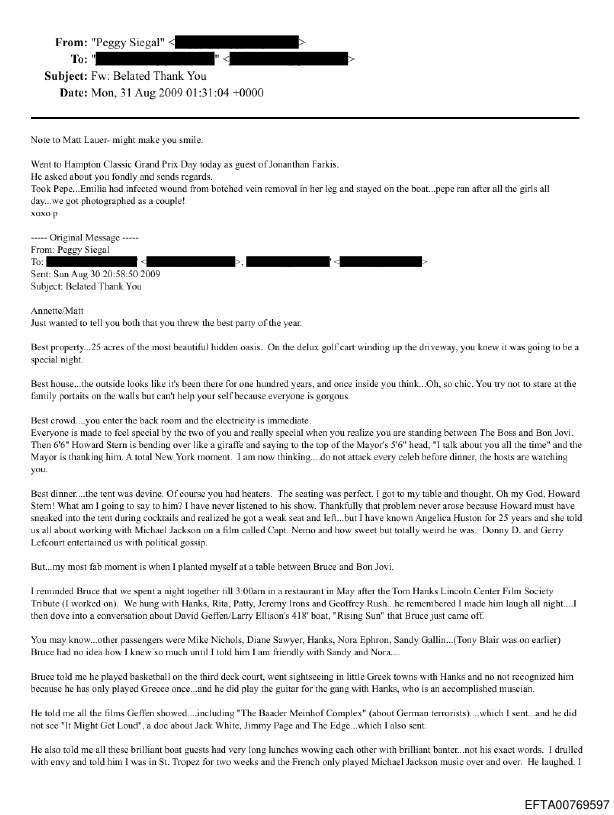
Siegal’s value to Epstein was her ability to normalize his name in spaces where he didn't belong. EFTA00769597, a 2009 email from Siegal to former Today show host Matt Lauer, illustrates how she operated.
Writing to thank Lauer for a party in the Hamptons, she gushes about the guest list, describing it as the “best night of my entire summer” because she got to meet Bruce Springsteen.
While this reads like celebrity worship, for Epstein it was a way in. Siegal’s 'fangirling' was the mechanism by which she ingratiated herself, and by extension Epstein, within popular culture. By maintaining these high-altitude connections, she ensured that when she vouched for Epstein, or brought him along as her endorsement, it carried the weight of an establishment.
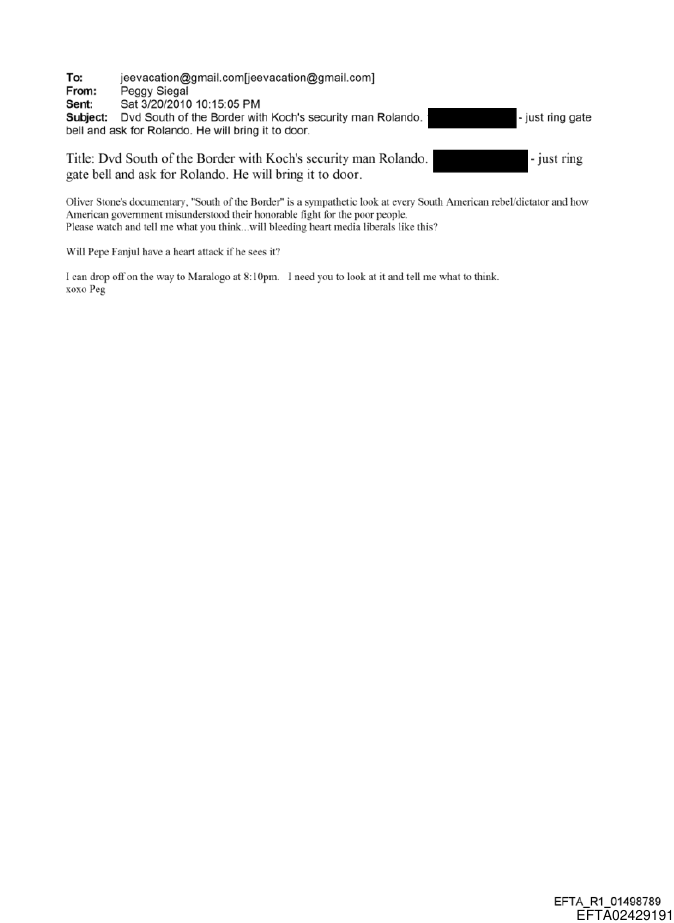
Another revelation in Siegal’s correspondence is a casual email from March 2010 that appears to challenge the official history of Donald Trump’s relationship with Epstein.
Publicly, the narrative has long been that Trump banned Epstein from his Mar-a-Lago club years prior. Yet, in EFTA02429191, a message regarding an Oliver Stone documentary, Siegal writes to Epstein: “I can drop off on the way to Maralogo at 8:10pm. I need you to look at it and tell me what to think”.
The email implies Siegal was shuttling materials between Epstein’s Palm Beach home and Trump’s club in a single evening. She even asks Epstein, “Will Pepe Fanjul have a heart attack if he sees it?”— linking the sugar baron, the President’s club, and the sex offender into an orbit of traded movies, payments, and meetings.
Whether it was paying the surgical bills of a powerful publicist like Peggy Siegal or lending out films to sugar barons, Epstein used his wealth to create a debt of gratitude. He was paying a tax to reenter and be accepted within high society. In exchange, they looked at a convicted sex offender and saw only a generous friend.
By 2014, the transaction was complete. The monster of Epstein was hidden yet more visible than ever. There was a social circle constructed around Epstein to legitimize him, giving him a sense of freedom to operate. The monster was no longer being kept in a gilded cage. His operations continued, perhaps now even more emboldened due to being connected within the private world.
Taken individually, these documents might seem like scattered artifacts of a wealthy life. But viewed together, they form a clear picture of the machinery that allowed a sex offender to operate in plain sight.
The 'Epstein Files' released by the DOJ are often scoured for conspiracy or blackmail. Yet the reality they reveal is clearly far more mundane and disturbing. Epstein did not need to blackmail the establishment into accepting him. He simply needed to make himself useful.
The tragedy recorded in these documents is not just that a predator existed, but that his return to power was so cheap. The social ban was a myth and the falling out with power brokers was porous at best.
In the end, high society didn't look the other way because they were forced to. They looked the other way because they wanted to borrow a DVD of the film ‘Lincoln’.
References and attached documentation:
-
Movie Log 2013 (EFTA00585883 - EFTA00585884): The spreadsheet tracking DVD screeners.
[Click to view Page 1]
[Click to view Page 2]
-
Disney World Email (EFTA02033290): Email from Lesley Groff establishing vacation timeline.
[Click to view Document]

-
Surgery Payment Emails (EFTA02177485 - EFTA02177486): Correspondence regarding medical bills.
[Click to view Page 1]
[Click to view Page 2]
-
Quid-Pro-Quo Email (EFTA02408549): Email from Peggy Siegal to Jeffery Epstein about 're-entry into society' (Warning: hateful language).
[Click to view Document]
-
Peggy Siegal / Matt Lauer Email (EFTA00769597 - EFTA00769598): Email detailing social events.
[Click to view Page 1]
[Click to view Page 2]

-
Mar-a-Lago Mention (EFTA02429191): Email regarding dropping off items.
[Click to view Document]